
New rules give China more excuses to enforce exit bans on foreigners
Last month, China’s State Council enacted two new economic regulations that are raising concerns among foreign firms that do business in China.
The new rules are aimed at punishing foreign companies that try to move their business away from China, including divesting from joint ventures and shifting to suppliers outside China. They are seen as a reaction to efforts of some countries to decouple from China and as a countermeasure to the rising risk of sanctions and other economic weapons.
They explicitly link business behaviour with national security issues.
The kinds of penalties mentioned in these new rules include fines, asset freezing and criminal liability.
But what interests us the most at Safeguard Defenders is the fact that both regulations explicitly allow for exit bans on foreigners suspected of violating these new rules.
In the past decade, China has been ramping up the number of laws giving it powers to enforce exit bans on foreigners and citizens.
In our 2023 report, Trapped: China’s Expanding Use of Exit Bans, we tracked four new laws between 2018 and 2022, that authorized exit bans to make 14 laws in total. One of them, the Supervision Law, allows exit bans to be placed on anyone connected to an investigation even if they are not a suspect.
These two latest regulations add to this growing number of legal instruments, raising the risk of exit bans even higher for those who travel to China on business.
Another key insight from that report is that many people don’t even know they have been put under an exit ban until they are at the airport trying to leave. Exit bans can last anything from days to years. Irish businessperson Richard O’Halloran was prevented from leaving China for nearly three years (2019 to 2022) because of a civil business dispute.
Article 16 of the State Council Provisions on Industrial and Supply Chain Security (国务院关于产业链供应链安全的规定) and Article 17 of the Regulations on Countering Improper Extraterritorial Jurisdiction by Foreign States (反外国不当域外管辖条例) both explicitly mention exit bans as one of several actions that can be taken (including fines and criminal prosecution).
The language of both regulations is expansive and vague. But it appears that companies, and people who work for them, can get in trouble if they:
Collect sensitive supply chain data and other information,
Take any action that harms China’s supply chains (such as moving business out of China),
Do not cooperate with investigations, which may include handing over a company’s own sensitive data, and
Follow or help enforce foreign government sanctions or restrictions against China.
Since 2023, when we first published our report on Exit Bans, there is strong evidence that the increasing trend in exit bans has only grown stronger.
China does not release public data on the number of exit bans, but we can use a proxy: the number of times exit bans is mentioned in verdicts on China’s Supreme Court Database (China Judgements Online or CJO).
The below chart shows the number of entries when we search for “限制出境” (exit ban) on the CJO for verdicts only for a period of 10 years spanning 2016 to 2025. These include both civil and criminal verdicts.
Between 2021 and 2024, exit ban mentions largely doubled every year. We expect 2025 to be an underestimate because it takes time for data to be uploaded to the system.
It is important to note that the number itself does not equal the number of exit bans issued for several reasons.
It is not the numbers here that are important, rather it is how they are changing.
The sharp increase in the CJO data (roughly doubling every year) is a strong indication that the number of exit bans is also growing very fast.
The real number of exit bans is likely much higher than this because many exit bans don’t even end up on this database because they are not connected with a judicial process. Additionally, these are verdicts—many cases which relate to exit bans may never reach this database because they are resolved before going to court. It is also known that the data is incomplete - a proportion of verdicts are never recorded on CJO, something which is thought to have only become more common in recent years, especially after COVID. This means it is possible the trend in rising exit bans is even more pronounced than this data indicates.
The data is also complicated by the fact that a single mention on the CJO can apply to several exit bans if a case involves multiple persons. Also, the person may take the case to appeal, so two mentions on the CJO can refer to the same exit ban.
The CJO exit ban data includes many civil cases, such as private lending disputes, corporate payment disputes and construction contract disputes. It also includes a smaller number of criminal cases and administrative cases.
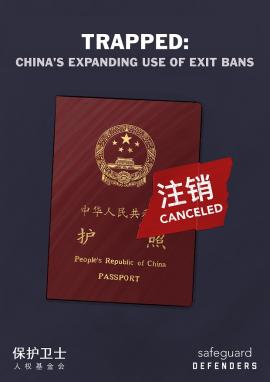
The earlier rise in exit bans from 2016 is likely linked to a nationwide measure launched that year aimed at ensuring those who owe debts and refuse to pay despite having the means to do so are punished. For more on exit bans and this data please see our report Trapped: China’s Expanding Use of Exit Bans.
Since Xi Jinping took power in 2012, China has expanded the legal landscape for exit bans and increasingly used them, sometimes outside legal justification, on everyone from activists to foreign journalists and for transnational repression and other coercive practices.
These latest regulations continue this worrying trend.
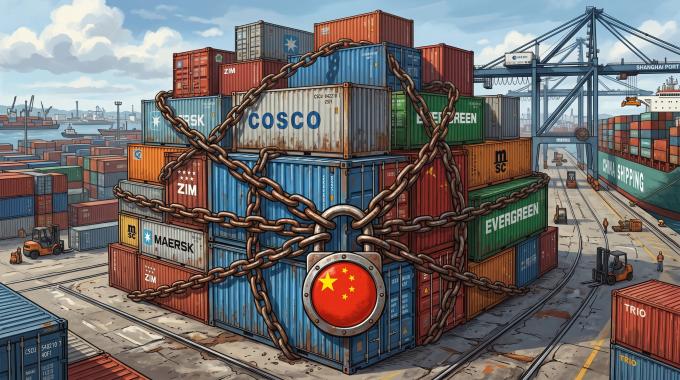
The image at the top of this article was generated with AI.


