China attempts to cancel SD event
Detention conditions and risks to foreign nationals in China, two former foreign detainees' testimony in Lisbon - and the Chinese Embassy's attempts to silence them.
Tomorrow, June 16, Safeguard Defenders (SD) releases its latest report: Behind Bars - A Survey on Detention Centre Conditions in China.
That same day, SD and the American Club of Lisbon (ACL) host a discussion on China's persistent use of arbitrary detention - and the rising risks it poses to foreign nationals.
The event, at Grémio Literário in Chiado, Lisbon, features direct testimony from two former European detainees: Peter Dahlin (Sweden) and Peter Humphrey (United Kingdom). Joining them is Grace Chen (Canada), former legal adviser to the UN Special Rapporteur on Torture.
[Details on both the report and the event are available below]
China's Embassy in Portugal would rather it didn't happen
In recent days, there have been at least two attempts to cancel or disrupt the Lisbon event.
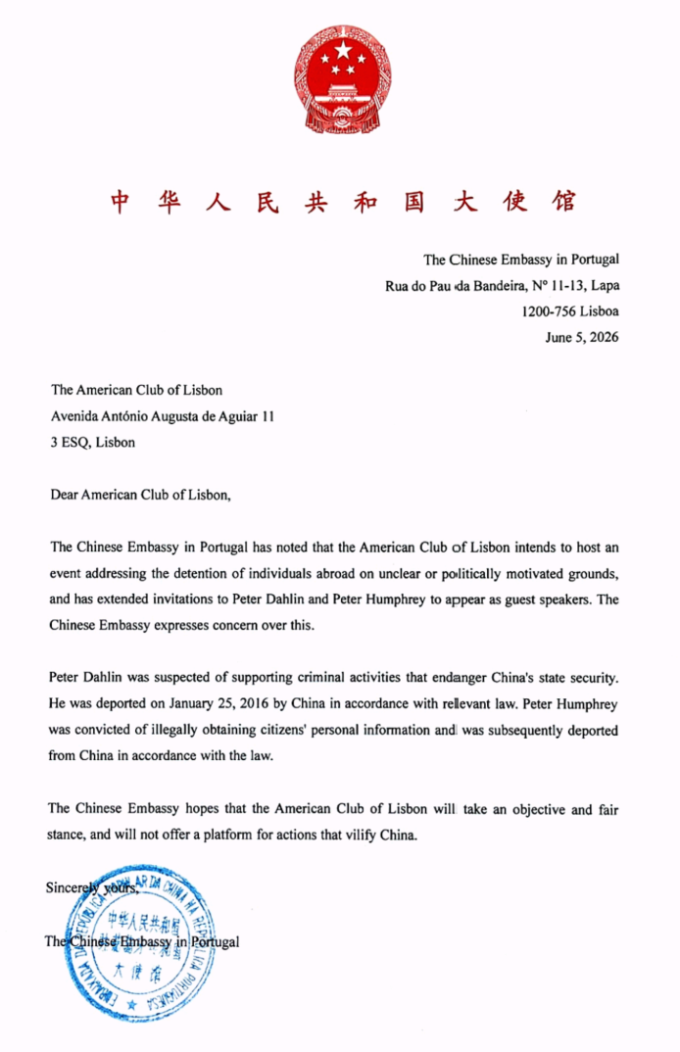
In a letter dated June 5, the Embassy urged the American Club of Lisbon to reconsider "offering a platform for actions that vilify China".
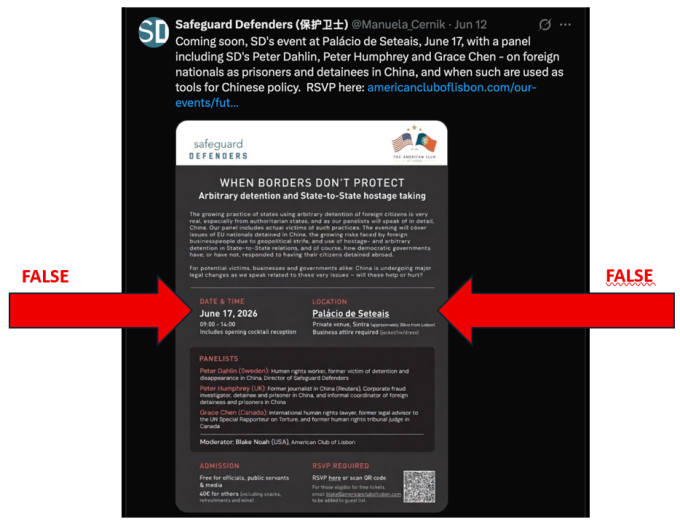
Days later, on June 12, one of the many X accounts impersonating Safeguard Defenders posted a doctored copy of the event poster. The fake changed the date, time, venue and location to mislead potential attendees. The same account pushed the false details to other users in the China human rights space by direct message.
Earlier this year, China's Embassy in Brussels similarly attempted to disrupt a discussion at the European Parliament on the same topics.
Why this matters to China
In November 2025, China's Ambassador to the U.S., Xie Feng, bluntly restated the CCP's "four red lines" at a US-China Business Council event. Public discussion of Taiwan, of democracy and human rights, of China's political system, and of its right to development is off limits - not just inside China, but worldwide. The CCP brands any breach "interference in China's internal affairs".
The Lisbon event, and the Behind Bars report, also cross two further fault lines.
In autumn 2022, the European Court of Human Rights (ECtHR) issued a landmark ruling barring extradition from all 46 Council of Europe member states to China. It found the country's detention and prison system to be one of "general violence," in breach of the prohibition on torture.
Since then, Beijing has fought hard to overturn that judgment state by state - through the courts and around them. Any new evidence of grave abuses in China's judicial and prison system cuts directly against that effort.
Finally, after the harsh Zero-Covid years, China launched a charm offensive - visa-free travel for many nations - to revive tourism and business. What it does not want is any public discussion on the growing risk of wrongful and arbitrary detention or exit bans on foreign nationals. These are not just reserved for actual crimes: Chinese authorities use them as leverage in commercial and state-to-state disputes - "hostage diplomacy".
Why this (should) matter(s) to all of us
The move against the Lisbon event is only the latest in a long line of PRC attempts - many of them successful - to suppress information that exposes widespread, systematic human rights abuse in China. Recent examples include pressure on German cities to drop their support for Tibet, and the cancellation of RightsCon in Zambia after sustained PRC pressure on the local government.
The CCP's "red line" on any public discussion of its rights record - anywhere - is the flip side of its propaganda and influence machine. To advance an increasingly aggressive agenda at home and abroad, the Party works to set and police every narrative about China. Anything that contradicts it must be silenced.
These efforts violate fundamental rights and freedoms enshrined in international treaties, regional instruments, and democratic constitutions. When the PRC suppresses those rights on foreign soil, it commits transnational repression and an unacceptable breach of sovereignty.
It also leaves people exposed. Burying real-time warnings about the risks of travelling to China strips individuals of the chance to prepare for them and protect themselves.
Democratic nations have a first duty to protect their citizens. Diluting these warnings - or tolerating their suppression - to satisfy the CCP's "red lines" may well amount to a dereliction of that duty.
Additional Background and Info
The Report
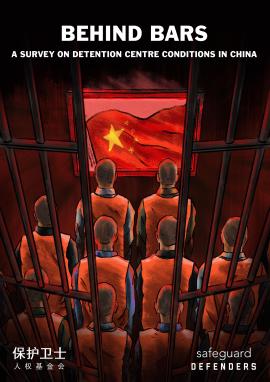
Behind Bars - A Survey on Detention Conditions in China draws on interviews with 84 former detainees. It finds that shocking abuses continue without relent across the country's 2,600-plus facilities, set for release June 16.
These include police beatings, the illegal denial of access to lawyers, and the use of inmate enforcers to keep order through intimidation and violence.
The report also compares domestic and international law and reviews legal commentary, tracing these abuses to the absence of clear protections for detention centers, exploitable legal loopholes, and weak oversight of detention-center police and practices.
As China's surveillance state shrinks the pool of public data and makes speaking out riskier, Behind Bars is a vital addition to the evidence on the systematic abuse of detainees - Chinese and foreign alike.
It is the first of two reports. A companion survey on prison conditions in China follows July 18.
The Actual Event