
Crackdown after fatal fire reveals growing mainlandization of HK
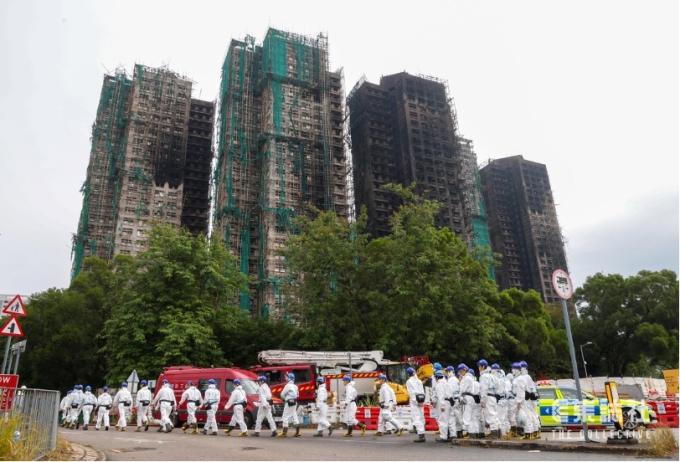
On Human Rights Day (10 December), Safeguard Defenders assesses how Hong Kong’s hardline response to a deadly fire reflects the city’s focus on national security over open society and safety.
The Hong Kong authorities’ reaction to a deadly fire that raged through a high-rise apartment complex killing at least 159 people last month did not only include rescuing survivors and addressing the disaster but also a sweeping crackdown on those who dared to raise questions.
This chilling move is yet another sign of the increasing mainlandization of Hong Kong, where disasters, man-made and natural, are most often met with arbitrary detentions, censorship and harassment of anyone who strays from the Chinese Communist Party’s chosen narrative.
In the days after the tragedy, the Hong Kong authorities:
- kicked out volunteers who were distributing aid at the disaster site;
- arrested a 71-year-old man for posting a critical comment online;
- detained a student on "sedition" charges who had launched a petition callling for accountability; and,
- directly copying from China’s playbook, accused foreign anti-China forces of spreading rumours.
Answering journalists’ questions about the arrests, Hong Kong’s Chief Executive John Lee said: “To anybody who dares to sabotage [social unity]… we will do anything we can to ensure that justice will be done.”
In effect, Hong Kong city’s first major human disaster since it passed its National Security Law in 2020 has been treated as a political security incident, with the focus on thanking Beijing for its support and calling out any criticism as foreign interference.
Before the fire broke out on 26 November 2025 in Wong Fuk Court, some residents had opposed a planned renovation project over soaring repair costs and an opaque tendering system. Despite this, the renovation went ahead anyway in July 2024.
For more than a year, residents warned the authorities that the netting and polystyrene materials used on building exteriors as part of the renovation work, were flammable. The government first said there were “no strict rules” on such materials, then later concluded the fire risk was “relatively low.”
Labour and fire departments issued multiple notices demanding safety improvements but these warnings were not enforced.
In the wake of the fire, investigators found that the netting failed fire-safety standards. To date, 13 people have been arrested on manslaughter charges in connection with the blaze— including contractors and a consultant.
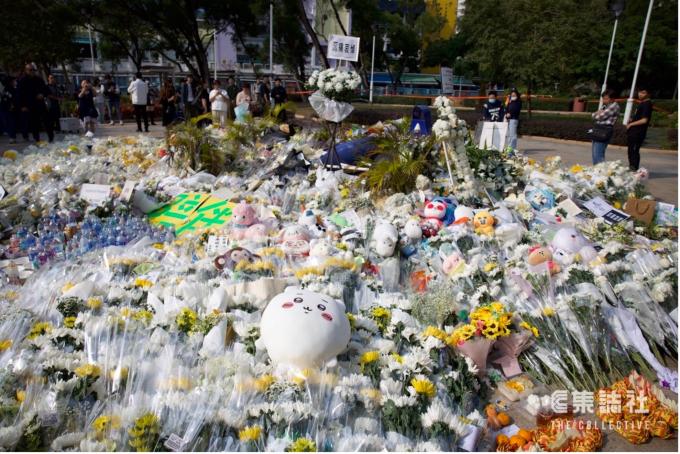
Grieving for those who perished in the fire, thousands of Hongkongers queued to lay flowers, communities donated supplies, and volunteers supported the displaced. Many were asking the most obvious, the most pressing question: What went wrong?
The authorities, mirroring their bosses in Beijing, moved quickly to silence these questions.
Two days after the tragedy, on 28 November, normally pro-government newspaper Ta Kung Pao (大公報) published an article hinting contractor corruption, then removed it within a day. A day later, police detained Miles Kwan, a student handing out flyers urging people to sign a petition he had set up calling for an independent investigation into the cause of the fire. Authorities also ordered volunteers to clear aid stations and replaced them with government “Care Teams.”
On 30 November, national security police arrested former district councillor Cheung Kam Hung and volunteer Lee Yuen Ching. Cheung was accused of “seditious intent”, but police gave no explanation of what actions led to the arrests.
On 2 December, a press conference organized by civil society groups was cancelled after national security police "invited" the organiser for a chat. The same day, a tunnel near the estate where residents had filled the walls with handwritten notes of support was cleared by authorities overnight.
The following day, the government accused “foreign and anti-China forces” of spreading rumours. Hailey Cheng, a student who created a GitHub archive about the fire and who had spoken to foreign media, and Ellie Yuen, a journalism graduate whose Instagram video discussed possible causes for the fire, had drawn more than 5.5 million views, announced online they would stop commenting “for obvious reasons.”
Lastly, over the weekend, in an unusual move, the government summoned international media outlets criticizing their coverage of the fire and issuing warnings. Meanwhile, national security police arrested a 71-year-old man for “seditious intent” after he posted “Beijing’s support is a show” on social media.
Hong Kong’s response is familiar to anyone who has observed how Beijing controls the aftermath of a natural disaster where there is a danger public anger may break out.
Some high-profile examples include Beijing's response following the devastating Wenchuan earthquake in 2008 when badly-built schools crushed thousands of children to death and the Wenzhou bullet train crash that killed dozens of people in 2011. In early 2020, after Li Wenliang, a doctor, tried to raise awareness about a Sars-like virus spreading in his hospital, police warned him to keep quiet. Weeks later, Li was dead from Covid and the virus had spread worldwide, causing a global pandemic and eventually killing millions of people worldwide.
Political scientist Minxin Pei said the strategy was learned from the Tiananmen massacre. In 1989, the Party sent in tanks to crush a monthslong anti-corruption protest in the Chinese capital killing thousands of people, mostly students.
“The lesson the party drew from Tiananmen is: You cannot wait for events to escalate. Problems must be crushed at the earliest stage... The goal is not simply to respond to the crisis but to pre-empt the possibility of collective expression."
Hong Kong-focused online media portal Pulse HK, staffed by diaspora journalists, cited Commentator Kau Kei as saying this approach is risk concealment rather than risk management. According to Kau Kei, the model typically includes the following steps:
- Hide any official failures
- Use disaster response to showcase “unity”
- Monopolise the narrative, only the government can define what happened
- Ban independent aid: decentralised assistance could highlight official failures
- Turn tragedy into a Party success: propaganda replaces accountability
For example, take the Urumqi fire tragedy.
On 24 November 2022, a fire broke out in a 21-storey building where residents were locked in their homes, allowed out only for short periods proscribed by the authorities. Officially, 10 people died.
The authorities blamed “narrow roads” and residents’ response, ignoring the fact that they had been locked at home for months and COVID barriers and controls in the compound and streets around the community likely obstructed escape and rescue.
As anger exploded online, videos and posts quickly vanished or were censored.
Grief and anger quickly turned into the White Paper Movement. Across China, students and citizens gathered and raised blank papers to represent the lack of freedom of speech.
Police later detained protesters, with officials blaming “hostile foreign forces” for the disruption. In January this year, documentary filmmaker Chen Pinlin was sentenced to three and a half years in prison for making a film about the protests.
The Hong Kong authorities appear to be fast learners.


